
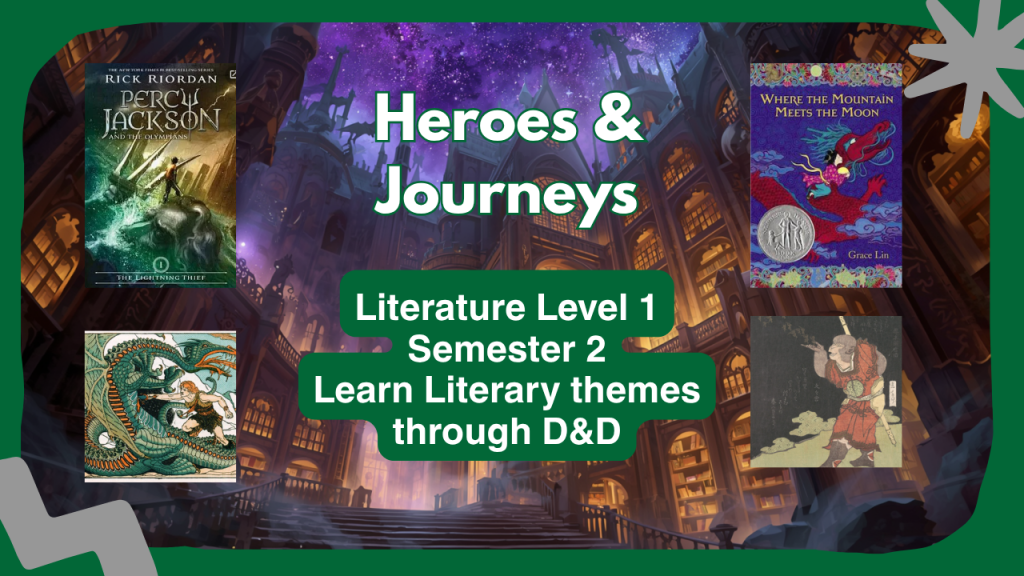
The adventure continues. In this 16-week live course for ages 10–14, small groups (up to 6) explore Chinese folklore, Greek mythology, and fantasy fiction. It caps off when they write and perform their own hero's journey using the D&D characters they've built all year.
Ages: 10–14 | Format: Multi-week course · Online | Length: 1 hr 25 min | Runs for: 16 weeks
The Hero’s Journey continues. Students explore Chinese folklore, Greek mythology, and Percy Jackson — then cap the year by writing and performing their own hero’s journey starring the D&D character they’ve built all year. Small groups, up to 6. No experience needed. Worksheets and pre-recorded lessons included.
Heroes & Journeys — Semester 2: The Transformation
Every week follows the same three-step rhythm, designed so students arrive at the live session already prepared — and leave having demonstrated real understanding through the adventure.
Step 1 — Watch (Start of Week) A pre-recorded video drops at the beginning of each week. Students watch it on their own time before the live session. The video covers that week’s reading — key literary concepts, vocabulary, the hero’s journey framework applied to the text — so the live session isn’t spent on passive review. Students come in ready to use what they’ve learned.
Step 2 — Complete the Worksheet (Before Live Session) Each week’s worksheet is built around the reading: character analysis, story mapping, drawing the hero’s journey arc, comparing heroes across cultures. No busywork — every activity is something students will use in the live session. Worksheets are D&D themed and designed to be engaging on their own.
Step 3 — Play (Live Session, 85 min) The live session is where the learning gets tested — through the adventure itself. Sessions run in three parts:
Warm-Up & Review (~15 min) — The DM opens with a quick discussion of the week’s reading. Students share observations, ask questions, and make connections before the quest begins.
The Adventure (~55 min) — The party continues their original campaign — the same characters they’ve been playing all year, now deep into the second act. The challenges they face, the choices they make, and the characters they meet all echo the hero’s journey stages they’re studying in the books. In Semester 2, the stakes are higher. The transformation is real.
DM Challenge (~15 min) — Each session closes with a direct literary challenge worth bonus HP. Students respond individually, the DM discusses, and the group closes the story beat for the week.
Unit 1 — The Monkey King Week 1 | Myth Primer Standards: CCSS.ELA-LITERACY.RL.5.2, RL.5.6, RL.5.9
Sun Wukong — the Monkey King — is arrogant, powerful, and deeply human. His journey from chaos to wisdom introduces the central theme of Semester 2: transformation. A one-week primer that resets the lens before the novels begin.
| Week | Text | What Students Study |
|---|---|---|
| 1 | The Monkey King (excerpt, Journey to the West) | The trickster as transformer; pride and the fall; comparing Eastern and Western hero archetypes |
Unit 2 — Where the Mountain Meets the Moon Weeks 2–6 Standards: CCSS.ELA-LITERACY.RL.5.1, RL.5.2, RL.5.3, RL.5.4, RL.5.6
Minli lives in a village of poverty and stories. Armed with a golden fish and a dream, she sets out to find the Old Man of the Moon and change her family’s fortune. Grace Lin’s Newbery Honor novel is a story nested inside stories — pulling from Chinese folklore to build one of the most beautifully structured hero’s journeys in middle grade fiction.
| Week | Reading | What Students Study |
|---|---|---|
| 2 | Chapters 1–8 | Minli’s Ordinary World; story-within-story structure; what the fortune-telling fish represents |
| 3 | Chapters 9–16 | The Call and companions; Dragon’s role as ally; folklore as emotional truth |
| 4 | Chapters 17–24 | Tests and embedded tales; why Lin weaves folk stories into the main narrative |
| 5 | Chapters 25–32 | The Ordeal; sacrifice; what Minli is really searching for |
| 6 | Chapters 33–End | The Return; discussion: what did Minli bring back? How does this compare to Tristan? |
Unit 3 — Percy Jackson & the Lightning Thief Weeks 7–12 Standards: CCSS.ELA-LITERACY.RL.5.1, RL.5.2, RL.5.3, RL.5.4, RL.5.6, RL.5.9
Percy Jackson thinks he’s a troubled kid. He’s actually a demigod — and someone has stolen Zeus’s master lightning bolt. Students who have spent the year with Theseus, the Hero’s Journey, and the trickster archetype will read Rick Riordan’s novel differently than they ever could have in September. The payoff is everything.
| Week | Reading | What Students Study |
|---|---|---|
| 7 | Chapters 1–4 | Percy’s Ordinary World; how Riordan modernizes Greek myth; ADHD and dyslexia as heroic traits |
| 8 | Chapters 5–8 | Crossing the Threshold; Camp Half-Blood; the mentor in myth and literature |
| 9 | Chapters 9–13 | Road of Trials; comparing Percy’s quest structure to Minli’s and Tristan’s |
| 10 | Chapters 14–17 | The Ordeal; betrayal; how Riordan subverts expectations |
| 11 | Chapters 18–20 | Transformation; Percy comes into his power; what that looks like on the page |
| 12 | Chapters 21–22 | The Return and revelation; discussion: how does the lightning thief twist the hero’s journey? |
Unit 4 — Capstone: Your Hero’s Journey Weeks 13–16 Standards: CCSS.ELA-LITERACY.W.5.3, W.5.4, SL.5.4, SL.5.5
No new reading. Students turn inward. Over four weeks, they use the Hero’s Journey framework to map, write, and present the story of their own D&D character — the one they’ve been playing all year. This is the moment the curriculum and the campaign converge. Students discover that the story they’ve been living in the game is the same story they’ve been analyzing in the books.
| Week | Focus | What Students Do |
|---|---|---|
| 13 | Map the Journey | Apply all Hero’s Journey stages to their own D&D character’s arc from the year |
| 14 | Write the Call | Draft the scene where their character first heard the call to adventure |
| 15 | Write the Transformation | Draft the moment their character changed — the Ordeal, the choice, the cost |
| 16 | Present in Character | Share their hero’s journey with the group, in character |
By the end of Semester 2 — and the full year — students have read four novels and four myth texts spanning Greek, Norse, West African, Chinese, and Black American storytelling traditions. They can recognize the Hero’s Journey anywhere, compare heroes across cultures and time periods, and write one themselves.
The capstone is the proof: students who complete the year leave with a piece of original writing, a character they know deeply, and a framework for reading story that will serve them for the rest of their lives.
0
There are no bookable times for this class listing yet.
Create a parent account so we can save your child, enrollment, reminders, and checkout details.
You’ll come back to this class after creating your account.