
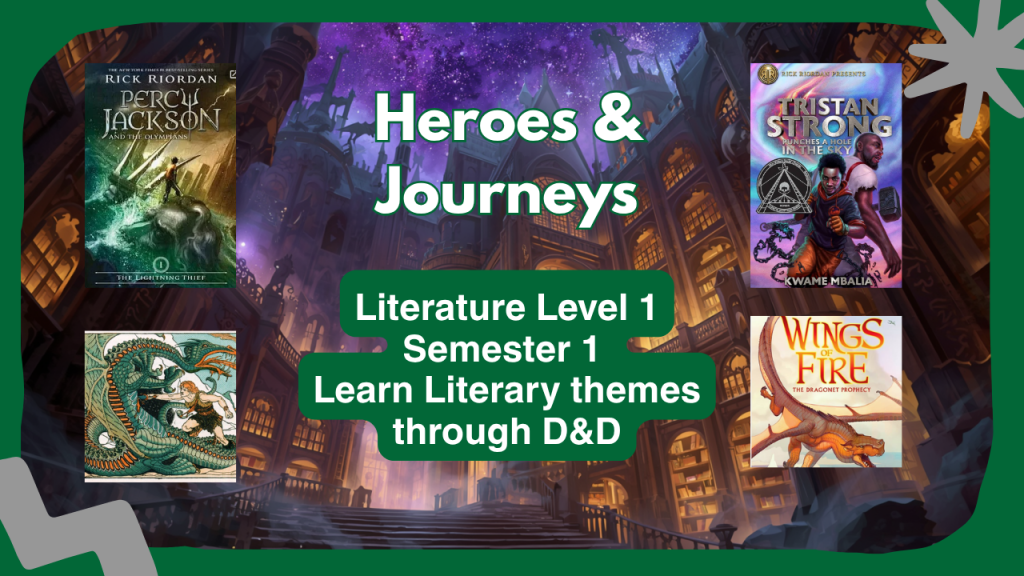
Literature meets D&D in this 16-week adventure for ages 10–14. Small groups (up to 6) explore what makes a hero through myth, folklore, and fantasy novels — while playing an original RPG campaign starring their own characters. No experience needed.
Heroes & Journeys — Semester 1: The Call
Every week follows the same three-step rhythm, designed so students arrive at the live session already prepared — and leave having demonstrated real understanding through the adventure.
Step 1 — Watch (Start of Week) A pre-recorded video drops at the beginning of each week. Students watch it on their own time before the live session. The video covers that week’s reading — key literary concepts, vocabulary, the hero’s journey framework applied to the text — so the live session isn’t spent on passive review. Students come in ready to use what they’ve learned.
Step 2 — Complete the Worksheet (Before Live Session) Each week’s worksheet is built around the reading: character analysis, story mapping, drawing the hero’s journey arc, comparing heroes across cultures. No busywork — every activity is something students will use in the live session. Worksheets are D&D themed and designed to be engaging on their own.
Step 3 — Play (Live Session, 85 min) The live session is where the learning gets tested — through the adventure itself. Sessions run in three parts:
Warm-Up & Review (~15 min) — The DM opens with a quick discussion of the week’s reading. Students share observations, ask questions, and make connections to the hero’s journey before the quest begins.
The Adventure (~55 min) — The party enters their own original campaign — a world the DM builds around the same hero’s journey stages students are studying in the books. The choices they face, the characters they meet, and the challenges they must overcome all echo the themes of that week’s reading. Students don’t just analyze the hero’s journey. They live it.
DM Challenge (~15 min) — Each session closes with a direct literary challenge worth bonus HP. Students respond individually, the DM discusses, and the group closes the story beat for the week.
Unit 1 — The Hero’s Journey Framework Weeks 1–2 | Myth Unit Standards: CCSS.ELA-LITERACY.RL.5.1, RL.5.3, RL.5.6, RL.5.9
Before the first novel opens, students learn the map. The Hero’s Journey — the ancient pattern underlying stories from every culture — becomes their framework for everything that follows.
| Week | Text | What Students Study |
|---|---|---|
| 1 | Theseus and the Minotaur | The Hero’s Journey stages; the Call to Adventure; what makes a hero worth following |
| 2 | Sigurd and the Dragon Fafnir | The Ordeal and the Road Back; comparing heroes across cultures; what myths teach us about courage |
Unit 2 — Wings of Fire: The Dragonet Prophecy Weeks 3–7 Standards: CCSS.ELA-LITERACY.RL.5.1, RL.5.2, RL.5.3, RL.5.4, RL.5.6
Five young dragons are told they are destined to end a war. But is a hero still a hero if the prophecy was never theirs to fulfill? Students read Tui T. Sutherland’s beloved novel through the lens of the Hero’s Journey — tracking Clay’s arc, the pressure of a chosen destiny, and what happens when the call is imposed rather than chosen.
| Week | Reading | What Students Study |
|---|---|---|
| 3 | Chapters 1–6 | Entering the Ordinary World; the Refusal of the Call; introducing character motivation |
| 4 | Chapters 7–12 | Crossing the Threshold; meeting mentors and allies; loyalty under pressure |
| 5 | Chapters 13–18 | Tests and Trials; character vs. prophecy; how setting reveals character |
| 6 | Chapters 19–24 | The Ordeal; moral dilemmas; who gets to define a hero |
| 7 | Chapters 25–End | The Road Back and Return; discussion: what did Clay earn, and what did he lose? |
Unit 3 — Anansi & the Trickster Hero Week 8 | Myth Primer Standards: CCSS.ELA-LITERACY.RL.5.2, RL.5.6, RL.5.9
Not all heroes carry swords. This week students meet Anansi — the West African spider-god who wins not through strength, but through wit, cunning, and story itself. A one-week primer that reframes what “hero” means before the next novel begins.
| Week | Text | What Students Study |
|---|---|---|
| 8 | How Anansi Got All the Stories | The trickster archetype; oral storytelling tradition; comparing Anansi to Clay and Theseus |
Unit 4 — Tristan Strong Punches a Hole in the Sky Weeks 9–14 Standards: CCSS.ELA-LITERACY.RL.5.1, RL.5.2, RL.5.3, RL.5.5, RL.5.6, RL.5.9
Tristan Strong doesn’t feel strong. Grieving his best friend, he tumbles into a world where the heroes from Black American folklore — Brer Rabbit, John Henry, Anansi — are real, endangered, and counting on him. Kwame Mbalia’s novel takes students deep into a hero’s journey that begins in loss and ends in earned power. Students compare Tristan to Clay, to Theseus, to Anansi — and to themselves.
| Week | Reading | What Students Study |
|---|---|---|
| 9 | Chapters 1–5 | Grief as the Ordinary World; reluctant heroes; what it means to be called |
| 10 | Chapters 6–10 | Supernatural aid; the trickster as guide; Anansi’s role revisited |
| 11 | Chapters 11–15 | Entering the special world; how Black American folklore shapes the narrative |
| 12 | Chapters 16–20 | Tests and allies; Tristan’s growth as a hero; theme of storytelling and power |
| 13 | Chapters 21–25 | The Ordeal; sacrifice and transformation |
| 14 | Chapters 26–End | The Return; discussion: how did Tristan change? What did he bring back? |
Unit 5 — Semester 1 Reflection Weeks 15–16 Standards: CCSS.ELA-LITERACY.RL.5.9, W.5.1, SL.5.4
No new reading. Students step back and look at the full arc of the semester — comparing the heroes they’ve met, identifying patterns in how different cultures tell the hero’s journey, and connecting it all to their own adventure.
| Week | Focus | What Students Do |
|---|---|---|
| 15 | Clay vs. Tristan | Comparative discussion: reluctant vs. chosen heroes; mythic roots of both novels |
| 16 | What Makes a Hero? | Creative wrap-up; students define the hero’s journey in their own words |
By the end of Semester 1, students have read two full novels and three myth texts, mapped the Hero’s Journey across Greek, Norse, West African, and Black American storytelling traditions, and practiced literary analysis every week — not as homework, but as the tools they needed to survive their own adventure.
They can identify the Hero’s Journey in any story. They can compare characters across texts. They understand that heroes come in many forms — chosen, reluctant, cunning, grieving — and that the archetype is a lens for understanding both fiction and their own lives.
Heroes & Journeys Semester 2: The Transformation continues with Grace Lin, Rick Riordan, and a capstone that asks students to write their own hero’s journey — starring the character they’ve been playing all year.
The adventure continues. In Semester 2, students cross into a new phase of the Hero’s Journey — transformation, identity, and the return. Through a Chinese-inspired fairy tale, Greek mythology’s most famous demigod, and a year-end capstone, students use their own D&D characters to answer the question every hero eventually faces: who did I become? Semester 1 is recommended.
0
There are no bookable times for this class listing yet.
Create a parent account so we can save your child, enrollment, reminders, and checkout details.
You’ll come back to this class after creating your account.